
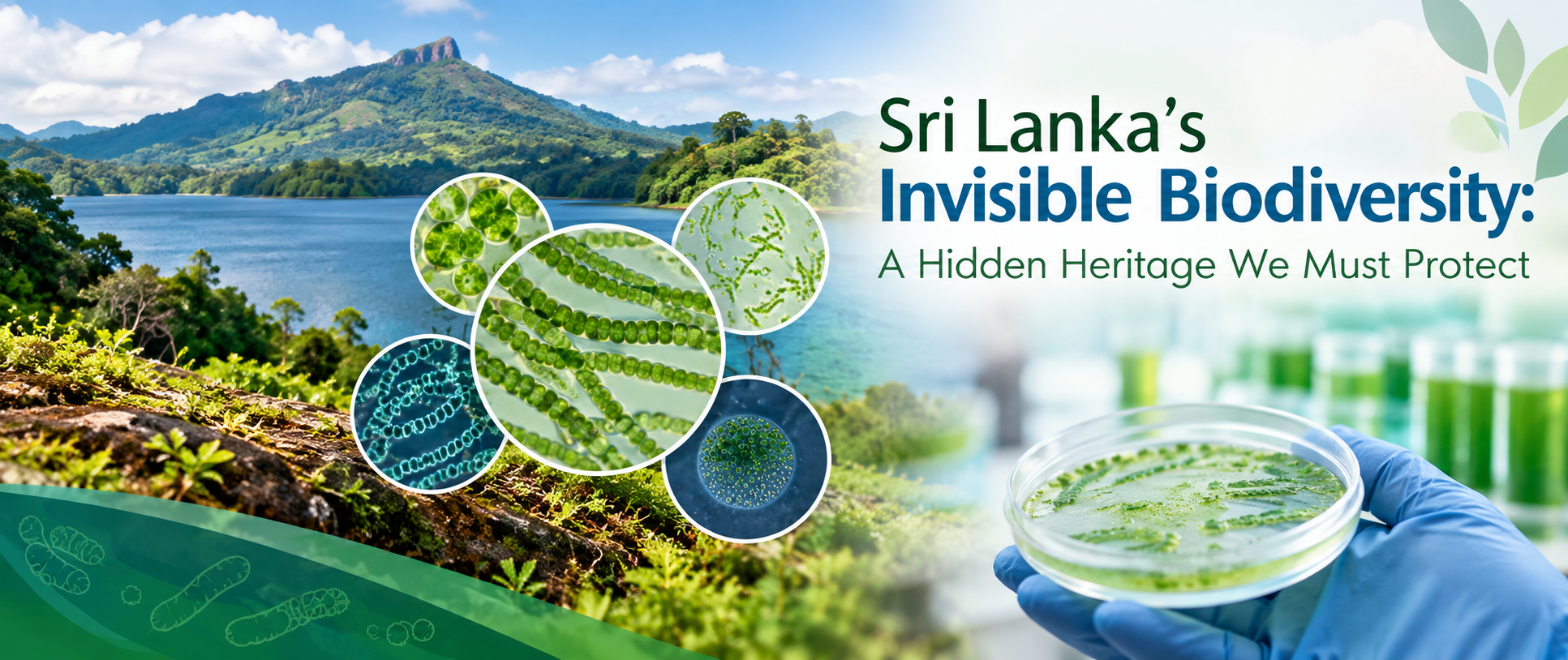
Sri Lanka’s Invisible Biodiversity: A Hidden Heritage We Must Protect
Sri Lanka is widely recognised for its remarkable biodiversity. As a tropical island, we are proud of our diversity of plants and animals, from the forests of the central highlands...
Sri Lanka is widely recognised for its remarkable biodiversity. As a tropical island, we are proud of our diversity of plants and animals, from the forests of the central highlands to the dry zone, wetlands and coastal ecosystems. But there is another, much less visible part of our biodiversity that deserves equal attention: our microbial diversity.
Microorganisms are everywhere around us, in our soils, water bodies, forests, agricultural fields, wetlands and coastal environments. Yet, unlike elephants, birds, orchids or medicinal plants, most of these organisms are invisible to us and remain largely unknown.
Our studies on cyanobacteria provide a glimpse of this hidden biological wealth. The diversity we have found in different Sri Lankan environments shows that our microbial resources are much richer than we may realise. Different environments appear to harbour microorganisms with different characteristics, adaptations and potential uses.
But biodiversity is not something we can take for granted.
Environmental changes, pollution, habitat destruction, changing land use, climate change and the loss of natural ecosystems can alter microbial communities just as they affect plants and animals. When an ecosystem changes or disappears, microorganisms adapted to that particular environment may also disappear before we even know that they existed.
This raises an important question: How can we protect something that we cannot see?
The first step is to know what we have.
We need to systematically record, identify and study our microbial diversity, including microorganisms from soils, freshwater, wetlands, agricultural ecosystems, saline environments and other unique habitats. Just as we maintain records and protected areas for important plant and animal species, microbial resources also need to be documented and conserved.
Culture collections can play an important role in this process. Selected microorganisms can be isolated, identified, carefully maintained and preserved so that they remain available for future research. Such collections are more than laboratories containing tubes of microorganisms. They are repositories of biological information and genetic resources.
This is particularly important for a country such as Sri Lanka. We may be a small island, but our environmental diversity has created opportunities for microorganisms to adapt to many different conditions. Some of these organisms may contain characteristics that could become valuable in the future for food, agriculture, environmental protection, biotechnology or other applications that we have not yet imagined.
If we lose them before studying them, we lose not only biological diversity but also future possibilities.
Protecting microbial biodiversity therefore should not be seen as a specialised concern only for microbiologists. It is part of protecting Sri Lanka's natural heritage.
Our forests, wetlands, rivers and reservoirs are not simply landscapes. They are living ecosystems containing an enormous diversity of life, much of which is still invisible and unexplored. Protecting these ecosystems is therefore also a way of protecting the microorganisms that live within them.
Cyanobacteria offer an excellent example of why this hidden biodiversity deserves our attention.
At the National Institute of Fundamental Studies (NIFS), efforts are being made to conserve some of this hidden biological wealth through the Sri Lanka Cyanobacteria Culture Collection. Cyanobacteria isolated from different Sri Lankan environments are being maintained as living cultures, creating a resource for identification, research and future applications. The collection brings together organisms that would otherwise remain only in their natural environments, where changes in those environments could put them at risk of being lost.
A culture collection also allows us to look beyond the present. A cyanobacterium that may appear to have little importance today could, through future research, reveal useful properties for natural pigments, food and nutrition, wastewater treatment, agriculture, biotechnology or other applications. Preserving these organisms therefore keeps future possibilities open.
Building and strengthening such collections is an important part of documenting Sri Lanka's microbial biodiversity. However, conservation cannot depend only on maintaining organisms in laboratories. We must also continue to protect the natural ecosystems from which they originate. The best protection for microbial diversity is ultimately the protection of the environments in which these organisms have evolved and continue to live.
Our biodiversity is therefore much greater than what we can see.
The next time we look at a pond, reservoir, paddy field, wetland or stretch of coastline, it is worth remembering that beneath the visible landscape is another world of life. Much of it remains unexplored. Much of it may have value that we have not yet discovered.
Our invisible biodiversity is part of our natural heritage. We need to discover it, understand it and conserve it before it is lost.